Your Customers Want to Order Online. Your Reps Still Matter.
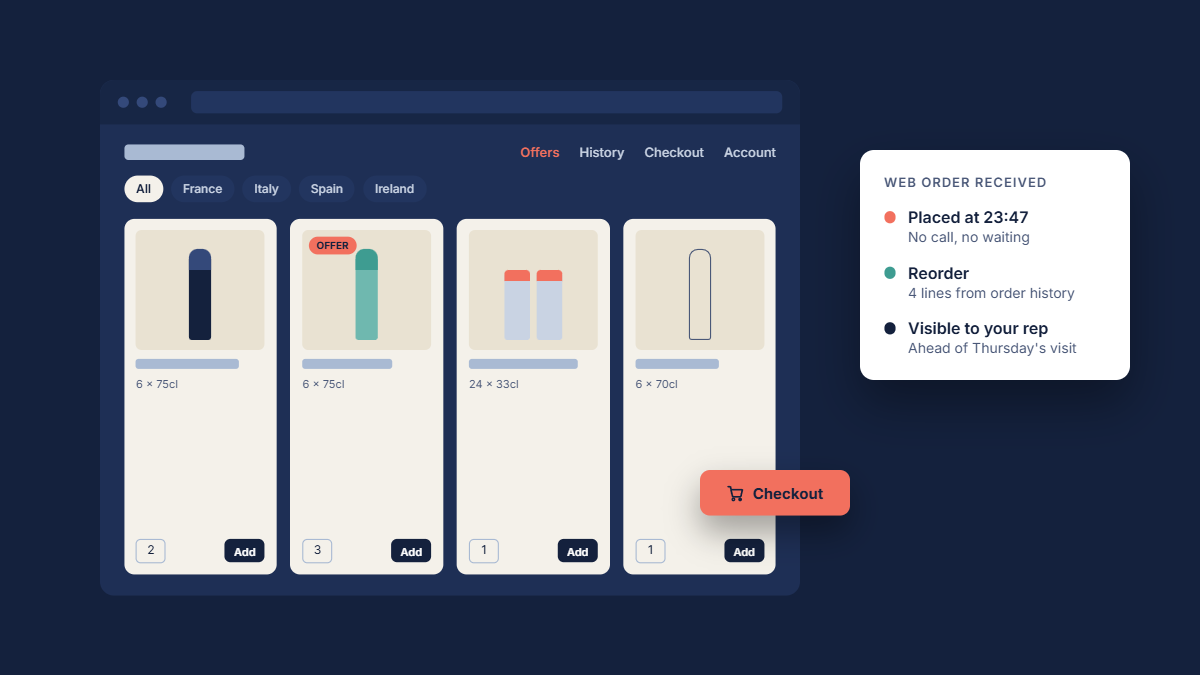
Your customers already shop online.
The buyer who runs a pub, a convenience store or a restaurant orders their own groceries, clothes and holidays online. They check their bank on their phone. They expect to see what they ordered last time with one tap.
Then they deal with their suppliers, and it's a phone call, an email or a wait for the rep's next visit.
That gap is closing quickly. Trade buyers increasingly expect to order the same way they shop at home: when it suits them, on any device, without having to chase anyone.
For distributors and brand owners, that raises a fair question. If customers can order online, what happens to the field sales team?
The hidden cost of traditional trade ordering
Most trade orders still arrive in a handful of ways: through the rep on a visit, over the phone to the office, or by email.
Each of these works. Each also has a cost that rarely shows up on a report.
- Phone orders tie up office staff and depend on someone being available when the customer calls.
- Email orders need to be re-keyed, and every re-keyed line is a chance for a mistake.
- Rep-only ordering means a customer who runs low on Tuesday waits until the rep's visit on Friday, or orders from a competitor instead.
There is a less obvious cost too. When a rep spends half the visit taking down a routine top-up order, that is time not spent on the conversation that grows the account.
A rep's visit is too valuable to spend as an order-taking service.
What a trade webshop changes
A B2B webshop gives trade customers a simple way to order directly, using their own account, prices and history. Here is what that changes in practice.
1. Customers order when it suits them
A bar manager doing a stock check at midnight can place the order there and then. No waiting for the office to open, and no forgetting by morning.
Orders that would otherwise be delayed, or lost to a competitor, get placed while the need is fresh.
2. Reorders take seconds
Most trade orders are repeats. With order history to hand, a customer can see what they bought last time, adjust a few quantities and check out.
That is faster for the customer and far less error-prone than a phone call.
3. The right prices, every time
A trade webshop should show each customer their own price list, case sizes and agreed terms, not a generic catalogue.
That removes one of the most common sources of order disputes: the customer expected one price and the invoice showed another.
4. Offers reach every customer
A promotion is only useful if customers know about it. A rep can mention it on a visit, but they can't visit everyone in the week it runs.
Offers shown in the webshop reach every customer the next time they log in to order.
5. Less re-keying, fewer errors
When a customer places an order directly, it arrives complete and in the right format. Nobody has to type it in from an email or a scribbled note.
The office spends less time on data entry and more time on the exceptions that need a person.
A webshop doesn't replace your reps. It frees them up.
The worry is understandable: if customers order online, do you still need people on the road?
The experience of most distributors is the opposite. The webshop takes the routine orders. The rep takes the opportunities.
A rep who no longer spends the visit writing down a standard top-up order has time to:
- Talk about new products and the range the customer isn't stocking yet
- Check the shelf, the display and the competition
- Sort out a problem before it becomes a lost account
- Agree a promotion and make sure it actually happens
The two channels work best when they share the same information. If a customer orders online on Monday, the rep visiting on Thursday should see that order, not discover it on the doorstep.
That works the other way too. A drop in online orders from a good customer is exactly the kind of signal a rep should know about before the next call.
When web orders and rep orders sit in one system, managers get the full picture of each account, not two halves of it.
What to look for in a B2B webshop
Not every online shop suits trade ordering. A consumer-style store with a basket and a card payment page misses most of what a trade buyer needs. Look for:
- Customer-specific pricing and terms: each account sees its own prices, not a public list.
- Trade units: products shown in the way customers buy them, such as cases and packs, not single items.
- Order history and quick reorder: the most-used feature for repeat customers.
- Offers and promotions: shown clearly to the customers they apply to.
- Simple search and filtering: by category, brand or origin, so a large range stays easy to browse.
- One system with your field team: web orders visible to reps and managers alongside everything else.
- Integration with your ERP: orders flow straight into accounts and dispatch without re-keying.
Above all, it has to be simple. If it is harder than picking up the phone, customers will pick up the phone.
Meet customers where they already are
Trade buyers aren't asking for less contact with their suppliers. They are asking for less friction.
Give them a quick, reliable way to place routine orders, and the conversations they have with your reps become more valuable, not less.
The webshop handles the transaction. Your team handles the relationship.
Online ordering, built into IntelliBrand
The IntelliBrand webshop lets trade customers browse your range, see their own prices and offers, check their order history and place orders online, at any time.
Because it is part of the same platform your reps and managers already use, every web order sits alongside rep orders, visits, surveys and audits on the customer's account.
If you'd like to see how the IntelliBrand webshop can work alongside your field sales team, get in touch to arrange a demo.